Drawing inspiration from the local bounty, Alpine dishes make the most of potatoes and cheese, baked or melted in countless ways with various additions, depending on which side of the slope you’re on.
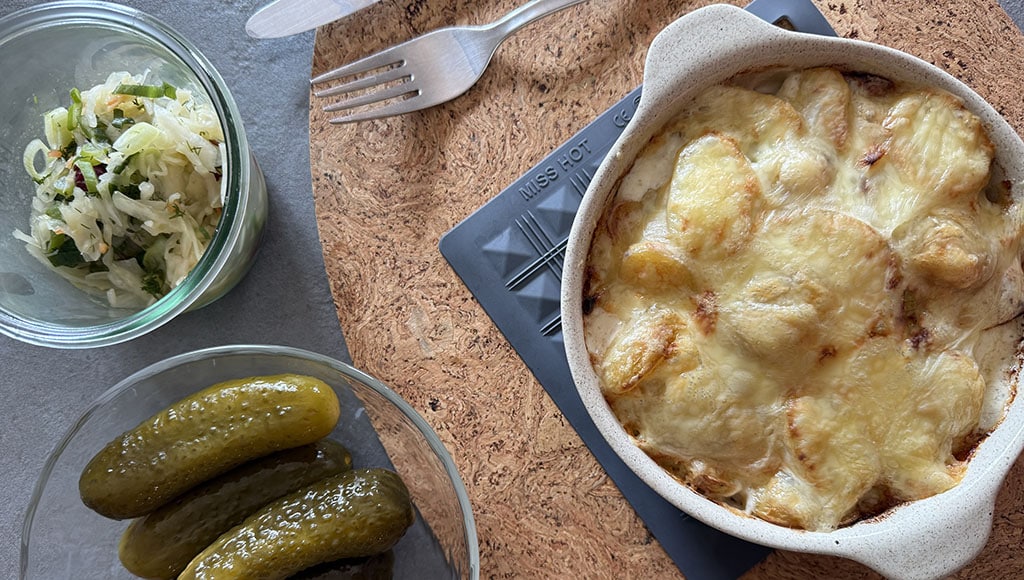
Take tartiflette in France, a classic Savoyard dish that consists of layering potatoes, onions, cream, bacon, and rich Reblochon cheese, then baking it all into delicious, gooey perfection. It draws from the older peasant dish called péla (named after the pan it was cooked in), using similar ingredients.
While the term “tartiflette” appeared in François Massialot’s 1705 cookbook Le Cuisinier Roïal et Bourgeois as a creative twist on the local dialect word for potato, tartifla, the modern version, with Reblochon as its star, emerged in the 1980s.
Local farmers and the Syndicat Interprofessionnel du Reblochon promoted it to use up excess stock of the soft, washed-rind cheese, famous for its melt-in-your-mouth texture. It quickly became an essential après-ski classic.
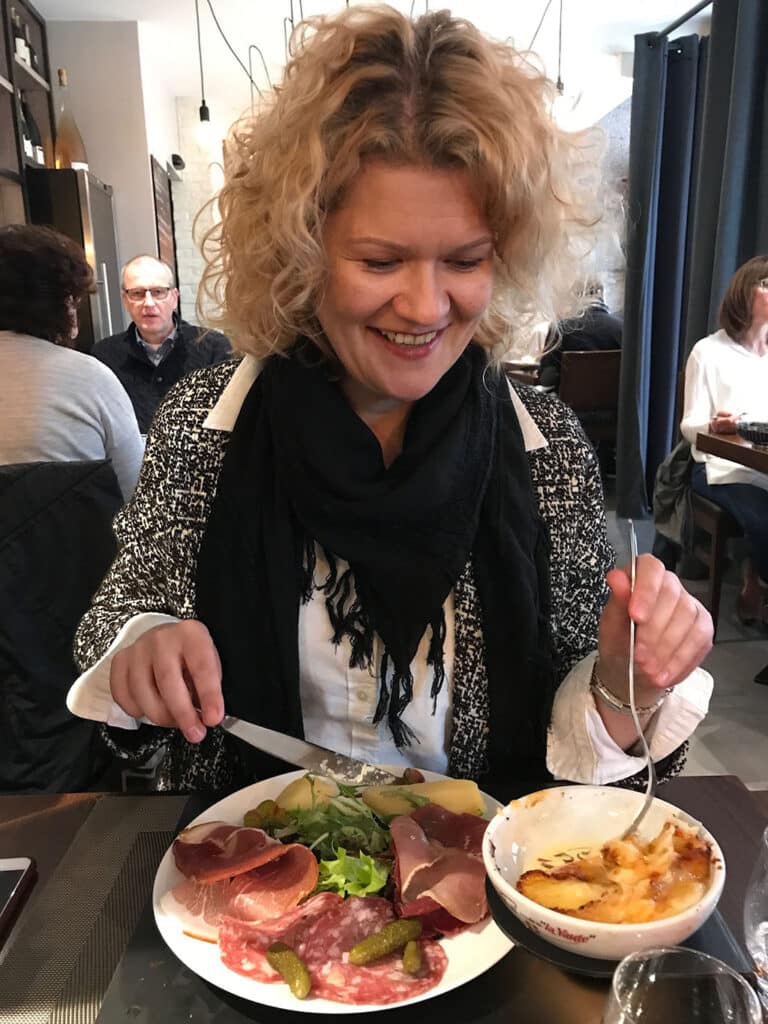
Then there’s the Swiss raclette. The word racler means “to scrape” in French. Legend tells of a shepherd (sometimes named Léon) in the Valais mountains who warmed a wheel of cheese by the fire and scraped off the melting parts to enjoy with potatoes. Switzerland still honours Léon’s tradition: a half-wheel (demi-meule) is placed under a heat source; once the top layer melts, it’s scraped onto boiled potatoes, often with charcuterie, gherkins, and pickled onions.
The modern way to enjoy raclette uses a tabletop grill with a hot plate and individual little pans. Everyone at the table melts their own portion of Raclette cheese (a semi-soft cow’s-milk variety prized for its melting properties) with accompaniments of choice. It’s convivial, customisable, and utterly comforting.
The iconic Swiss fondue needs little introduction. This pot of melted cheese, into which cubes of bread are dipped, ranks among Switzerland’s most beloved dishes. Interestingly, until the 1930s it remained largely regional, but the Swiss Cheese Union (Schweizerische Käseunion) launched an aggressive campaign to boost cheese consumption. The effort succeeded brilliantly, turning fondue into a national symbol, perhaps with a wink to their French neighbours.
Käsespätzle is the Tyrolean (and broader Austrian/Southern German) answer to winter hunger. Popular in Austria, Vorarlberg, Tyrol, Swabia, and beyond, it’s a hearty bowl of homemade egg noodles (Spätzle) tossed with melted mountain cheese and crowned with crispy fried onions. Think Alpine mac and cheese: creamy, carby, and gloriously satisfying. A close cousin is Kaspressknödel, cheese and potato (or stale bread) dumplings fried until crisp. It is a favourite vegetarian option in ski huts and mountain inns.
Italy offers its own take on the Alpine potato-and-cheese theme. Fonduta Valdostana, from Valle d’Aosta, is a creamy, indulgent, communal fondue made with Fontina cheese, enriched with cream and egg yolks. Unlike the Swiss version, it skips garlic and alcohol (and wine), relying instead on gentle melting for its silky texture. For extra decadence, it’s sometimes finished with shaved white truffles from neighbouring Piedmont. Served with crusty bread for dipping, or poured over polenta or potatoes, it’s pure mountain luxury.
Pizzoccheri is another staple of the Italian Alps, hailing from Valtellina in Lombardy. This hearty bake combines buckwheat pasta, potatoes, cabbage, and melted cheese (typically a mix of Valtellina Casera DOP and Grana Padano or Bitto). Buckwheat, introduced in the 17th century, proved more resilient than wheat to the valley’s harsh winters, quickly becoming a farmer’s staple. Though fields of buckwheat have shrunk dramatically, in places like Bormio and Livigno, pizzoccheri remains the go-to refuel after a gruelling day on the slopes.
Whatever the country or dish, one thing is certain: these wonderful, indulgent creations deliver the comfort and recharge that anyone wandering the Alpine slopes, Olympians and spectators alike, truly needs.
Read more about food from Irina Mikhailava: Kaiserschmarrn: an authentically Austrian sweet pancake or Galette des Rois: a journey through centuries of Kings’ Cake tradition or Comfort in every spoonful: the magic of soup