Pigs were among the earliest livestock domesticated, dating back to the Neolithic period around 10,000-9,000 years ago. They descend from the wild boar (Sus scrofa), an intelligent, adaptable species native to much of Eurasia and parts of North Africa.
In the Iberian Peninsula, these pigs found an ideal home: vast oak-filled meadows known as the dehesa. This unique habitat fostered an extraordinary evolutionary adaptation — the pig’s ability to marbleise fat throughout its muscle — transforming an ordinary animal into the world-renowned Iberian black pig.
The dehesa is a biodiverse ecosystem where oak trees, especially holm oaks (Quercus ilex) and cork oaks (Quercus suber), play a central role. These ancient trees produce acorns — bellota in Spanish or bolota in Portuguese — that form the cornerstone of the pigs’ diet.
Between October and February, during the Montanera season, the pigs are released into the dehesa to roam freely, foraging on acorns, roots, herbs, and grasses. This natural fattening process is key: constant exercise, combined with the rich acorn diet, distributes fat evenly across lean tissue, infusing the meat with unparalleled flavour. During this period, pigs can gain 100-110 kilograms, making Montanera essential to producing the premium quality of Ibérico products.
In Spain, the Asociación Interprofesional del Cerdo Ibérico (ASICI) certifies the authenticity, breed purity, and production methods of Iberian pig products, whether fresh or cured. The term “Cerdo Ibérico” refers to the Iberian black pig in Spanish.
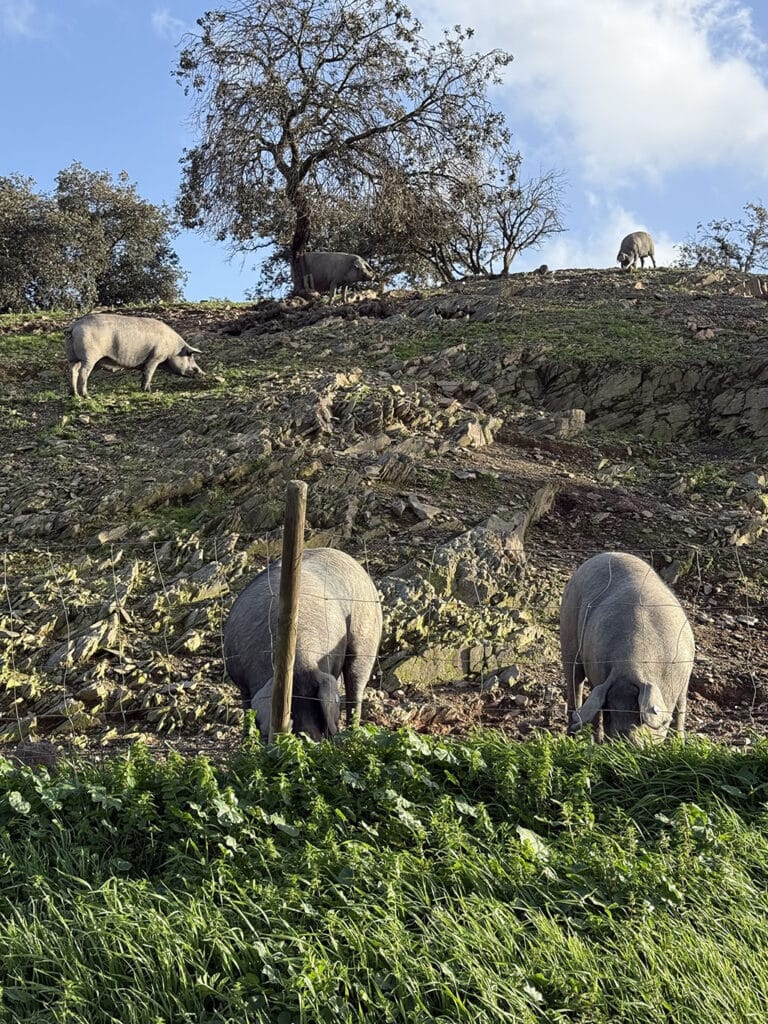
Only pigs that are 100% pure Iberian breed (both parents fully Iberian) and acorn-fed during Montanera receive the prestigious black label — the highest designation. This grade is widely known as pata negra (“black hoof”), a term that pays tribute to the breed’s characteristic dark trotters. While not every Iberian pig has fully black hooves, the rugged, worn state of the hoof often indicates an active, free-roaming life, which correlates with superior fat distribution and meat quality.
Other classifications include:
- Jamón Ibérico de Bellota (red label): from pigs with at least 50% Iberian breed (often crossed with Duroc), but still acorn-fed during Montanera.
- Jamón Ibérico de Cebo de Campo (green label): from Iberian pigs (50-100%) reared outdoors in the countryside, fed a mix of natural forage and supplemental feed.
- Jamón Ibérico de Cebo (white label): from Iberian pigs raised on farms and fed primarily commercial feed.
In Portugal, the Iberian pig is called Porco Preto and is primarily reared in the Alentejo region. Portugal adheres to the EU’s Protected Designation of Origin (PDO) system, known locally as Denominação de Origem Protegida (DOP). The most prestigious examples are Carne de Porco Alentejano DOP and Presunto de Barrancos DOP, which guarantee acorn-fed, 100% Iberian (Porco Preto) pigs raised under strict traditional methods. Names like Porco Preto, Porco Alentejano, or Porco Preto do Campo affirm the breed’s provenance, though they may not always ensure full acorn-fattening protocols.
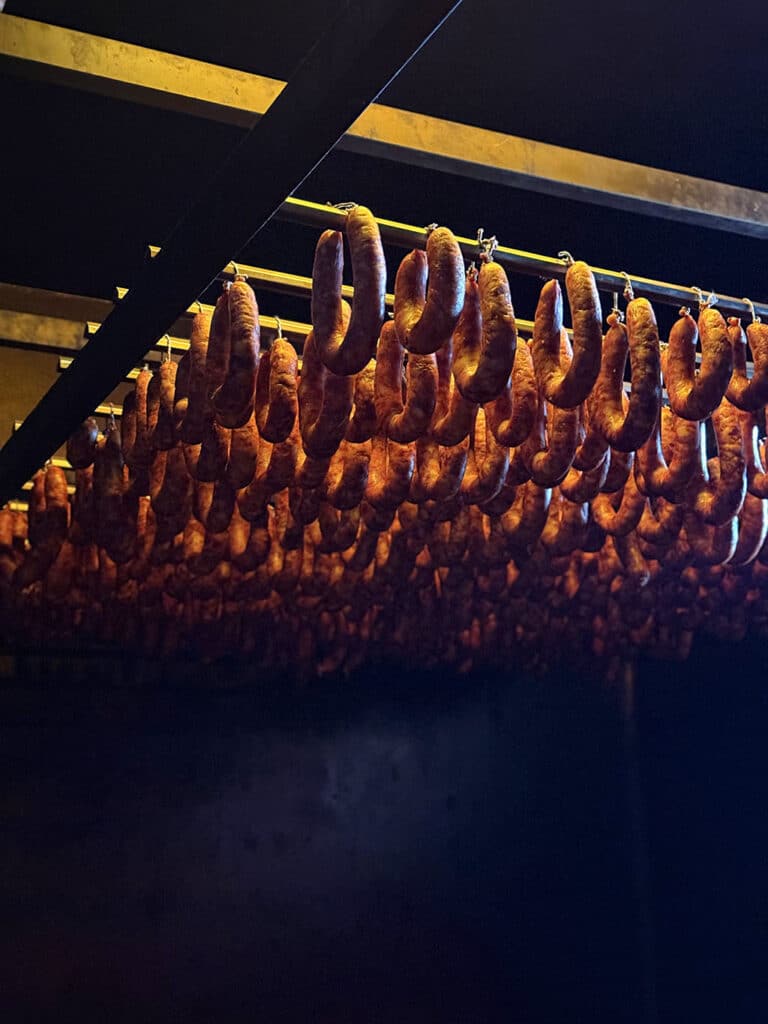
The tradition of rearing and curing Iberian pigs stretches back to Celtic times, when inhabitants of the peninsula developed early methods for preserving pork. The Romans, renowned for their lavish banquets, greatly admired these cured meats and refined preservation techniques.
During the Middle Ages, a poignant custom emerged among newly-converted Jewish communities (conversos or marranos), who publicly fattened pigs to demonstrate their Christian faith and evade suspicion from the Inquisition. Echoes of this practice survive today in the Marrano de San Antón tradition.
Each year, on June 13, in the town of La Alberca (Salamanca province), a pig named Antón is blessed by the priest, fitted with a bell around its neck, and released to roam the streets freely. For the next several months, residents care for it — providing food, water, treats, and shelter — honouring a custom that dates back centuries.
The celebration culminates on the feast of St. Anthony (January 17 or the following Saturday), patron saint of livestock, often depicted with a small pig at his side. Historically, the Order of Hospitallers of St. Anthony used pig fat to treat skin ailments, known as “St. Anthony’s Fire”.
The festivities end with a raffle: the pig is awarded to a lucky resident (with proceeds often supporting charity), and the cycle renews respect for an animal that has given so much to the community — and to humanity at large.
This enduring bond between people, land, and pig continues to produce one of the world’s most celebrated culinary treasures.
Read more about food from Irina Mikhailava: Alpine comforts or Kaiserschmarrn: an authentically Austrian sweet pancake or Galette des Rois: a journey through centuries of Kings’ Cake tradition