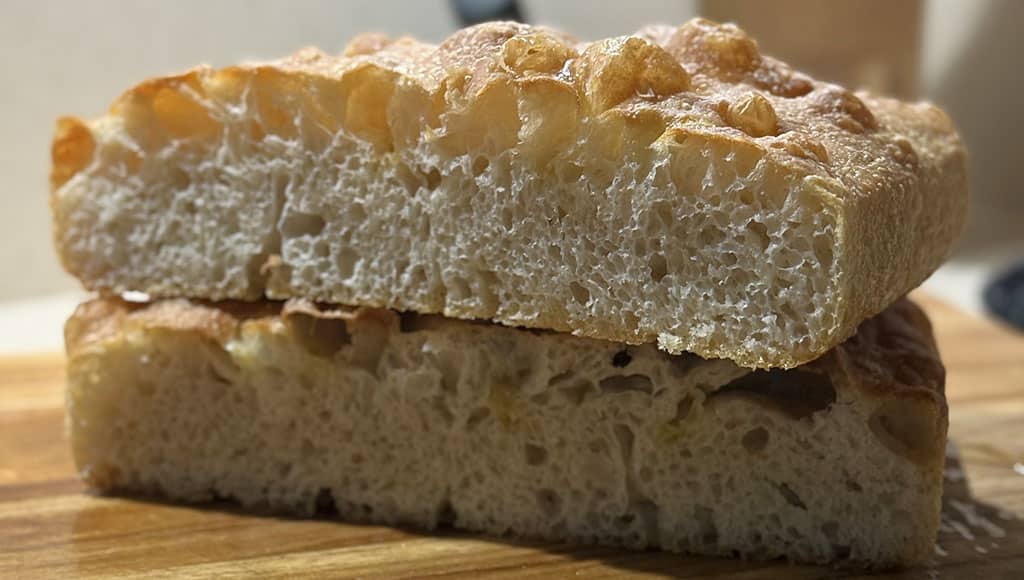
I remember clearly when focaccia first entered my world. June 2012. Rome. Heat. Lunch break. I can’t quite recall what was ordered, but what I can recall is the basket of the hand-torn, fluffy white bread.
Salty, fatty and chewy, focaccia made an impression just by resting on a napkin. Once tried, it instantly made friends with my tastebuds and won over my heart. In combination with a glass of prosecco, it felt like heaven. I was ready to call it a day and stay there forever.
Ever since, I have been on a hunt for a good focaccia and, even in Italy, it is not always a done deal. At its core, focaccia is just a flat bread made with flour, water, yeast, salt and olive oil. But this simplicity should not be underestimated. Focaccia is quite a diva!
Firstly, in order to produce the desired mouthfeel, a high protein flour is required, namely at least 12-14% protein content. The level of protein contributes to the development of the gluten network, responsible for the elasticity and extendibility of the bake.
To activate this protein, flour needs water which, when evaporated, also contributes to the overall spring. However, to achieve the softest and strongest expression of the flour, as in the case of focaccia, the flour has to be highly hydrated.
Recipes often call for 80% hydration and above. Those who have tried know that these doughs are not easy to handle. Their unruly texture sticks to everything it meets and attempts to escape every time it is lifted. The secret is in working it with fervour. Scoop, lift and slap. Scoop, lift and slap. Proceed for at least 10 minutes so that gluten gets its workout.
With time, the hands will begin to register the change in texture: the dough becomes less sticky; it develops a smooth, dome-like shape; and it starts to hold its form.
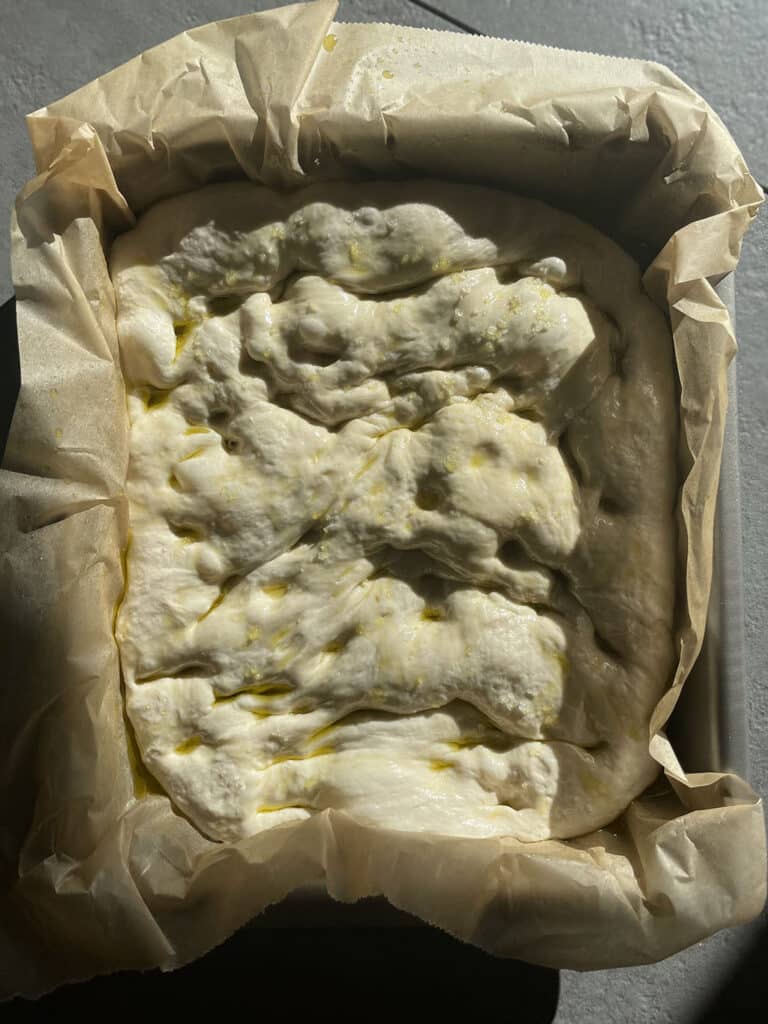
The olive oil can be of help here too. Oil and water don’t mix, so brushing hands with the olive oil can assist in dealing with the disobedient dough. Since it is a natural tenderiser and is required in the recipe anyway, it seems that using olive oil can be a win-win.
Furthermore, focaccia needs time. Its flavour gains tremendously from a so called ‘cold retard’, a baking technique where dough is placed in a refrigerator to slow down fermentation and to allow lactic acid bacteria to develop a deeper taste.
One of my most successful recipes (from a magnificent book called Sift by Nicola Lamb) spreads the making of focaccia over three days. Once mixed, there is not much work, but observation, involved during these days. The result, however, is definitely worth the wait!
Last but not least, focaccia requires high heat when baking. High temperatures send the yeast into the final frenzy. As it dies off, the yeast produces CO2 giving focaccia its oven spring. It is not for no reason that the name comes from panis focacius meaning “hearth bread”. Traditionally baked in the coals, it derives from the Latin word focus, meaning the “centre” or “fireplace”.
In Italy, there are several focaccia variations. The classical recipe, aka Focaccia Genovese or fügassa, is a thick (about 2-3cm) billowy bread, commonly associated with Liguria where it is eaten at breakfast, lunch and dinner.
In Liguria, there is also Focaccia al Formaggio di Recco, the kind that is laced with stracchino cheese.
Sardenaira is typical of the Sanremo area and is flavoured with anchovies and sardines. In Tuscany, focaccia is known as schiacciata, which means, “squashed”. It is usually thinner and firmer than Ligurian focaccia.
In the southern region of Puglia, focaccia is often made by adding boiled potatoes to the dough, and is topped with olive oil, cherry tomatoes and sometimes black olives.
Similar types of breads are found all over the world. They travelled there with Genovese sailors who brought focaccia with them whilst exploring the world. Whether it is the fougasse of France, the fugazza of Argentina, the hogaza of Spain or the focaccia in Italy, one thing is common – the unwavering popularity of this bread and the unbreakable allegiance that is sworn to it on a daily basis.
Read more of Irina Mikhailava’s articles: Pomegranate passion: recipes, benefits and ancient roots, Cepelinai: a taste from the road! or From the Alps to the table: The story behind Swiss cheese